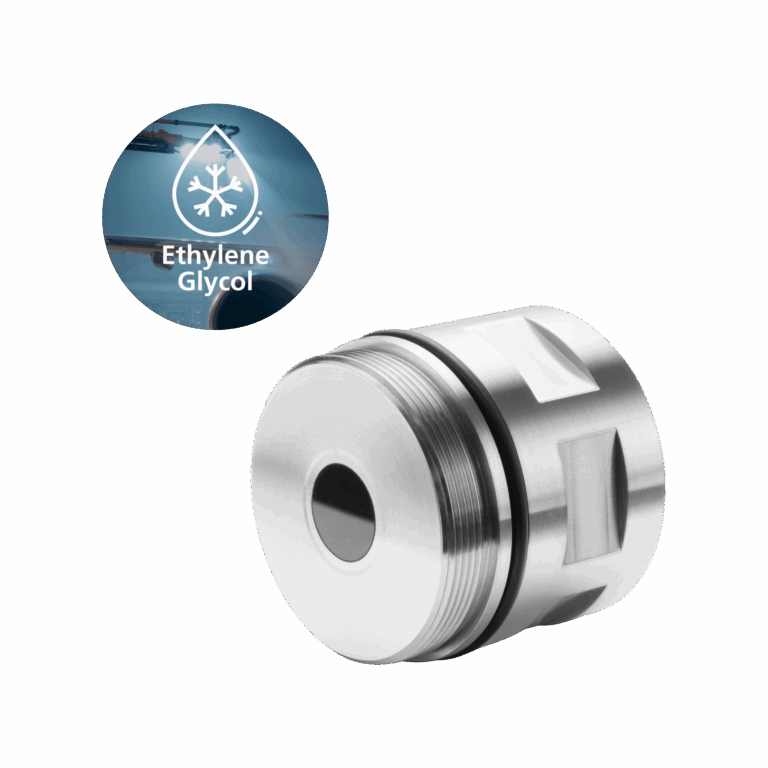
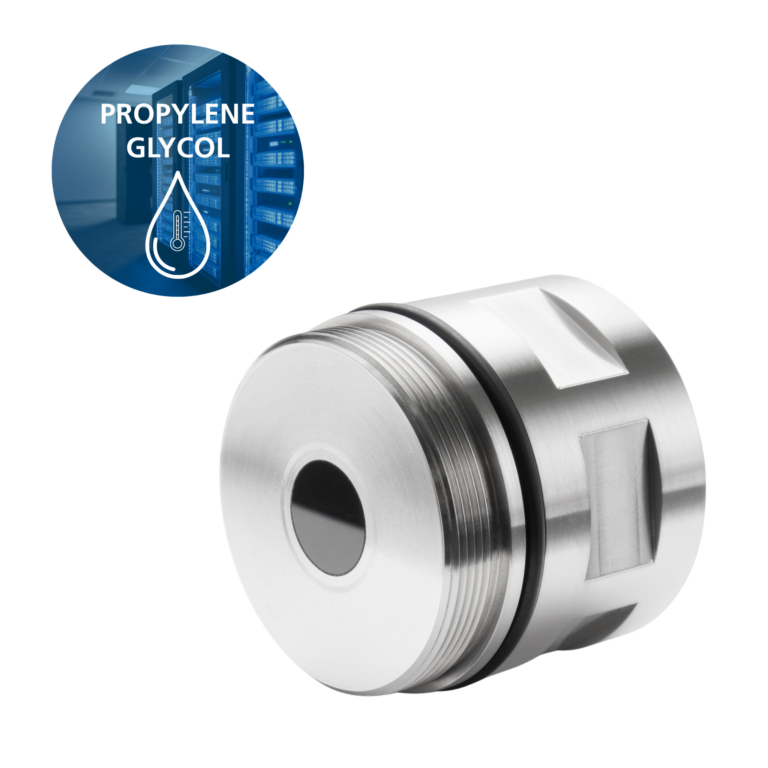
Aircraft deicing fluid concentration monitoring helps airport operators, deicing service providers, and fluid recovery operators detect dilution and concentration changes in glycol-based fluids. Inline refractometry continuously measures refractive index and, with a suitable fluid-specific correlation, provides real-time information about concentration-related changes. SCHMIDT + HAENSCH offers compact iCS² inline concentration sensors for continuous monitoring of propylene glycol and ethylene glycol-based process fluids.
Aircraft operating under winter conditions require effective ground deicing and anti-icing procedures to remove frozen contamination and help prevent its accumulation before takeoff. Many aircraft deicing and anti-icing fluids are glycol-based formulations containing propylene glycol (PG) or ethylene glycol (EG), water, and application-specific additives. This application focuses specifically on glycol-based aircraft fluids.
Why Is Aircraft Deicing Fluid Concentration Monitoring Important?
Aircraft deicing fluid concentration monitoring is important because the concentration of a glycol-based fluid influences its freezing-point characteristics. Water ingress, incorrect mixing, unintended dilution, or water loss through evaporation can change the fluid concentration and therefore its freezing-point characteristics. Dilution can reduce the glycol concentration, while evaporation during heating can increase it. If the fluid moves outside the concentration range specified for the particular product, the required freezing-point protection may no longer be maintained.
For airport operators, deicing service providers, and quality-control teams, typical measurement challenges include detecting dilution quickly, verifying the concentration of prepared fluids, identifying mixing deviations, and monitoring changes continuously rather than only at individual sampling points. Refractive index is an established parameter for this purpose because it changes with fluid composition and is related to the concentration of the freezing-point depressant. For formulated aircraft fluids, however, acceptable refractive-index values and concentration relationships are specific to the individual fluid and should be evaluated using the relevant product data and fluid-manufacturer specifications.
How Does Inline Refractometry Measure Glycol-Based Deicing Fluids?
An inline process refractometer continuously measures the refractive index of the fluid directly in the process. In defined propylene glycol-water or ethylene glycol-water mixtures, refractive index can be correlated with glycol concentration. Because refractive index is temperature-dependent, temperature must also be taken into account when determining a concentration value.
Aircraft deicing and anti-icing fluids are formulated products and may contain additional components such as corrosion inhibitors, surfactants, dyes, and other additives. Type II, III and IV fluids additionally contain thickening agents or rheology modifiers that produce their characteristic non-Newtonian, pseudoplastic behavior. These constituents can also influence the measured refractive index. For formulated aviation fluids, quantitative concentration measurement should therefore use fluid-specific reference data or an application-specific correlation between refractive index, temperature, and the required process parameter.
With a suitable correlation, inline refractometry can continuously detect dilution, concentration changes, and deviations from a defined operating range. It provides a concentration-related process parameter, but does not by itself establish the complete conformity or serviceability of an aircraft deicing or anti-icing fluid.
What Must Be Considered for Type I and Type II, III and IV Fluids?
Aircraft deicing and anti-icing fluids have different formulations and performance requirements. SAE Type I fluids are Newtonian fluids used primarily for deicing, while Type II, III and IV fluids are thickened, non-Newtonian, pseudoplastic fluids designed to provide extended anti-icing protection.
Refractive index is an important quality-control parameter for these fluids, but it does not provide a complete assessment of fluid quality. In particular, viscosity is a critical parameter for Type II, III and IV fluids because their rheological behavior contributes directly to their intended performance. Other parameters may also need to be verified depending on the applicable fluid specification, manufacturer instructions, and operating procedure.
Inline refractometry should therefore be used as part of an overall fluid-monitoring and quality-control strategy rather than as a replacement for other required fluid tests.
Where Can Inline Refractometers Be Used in Aircraft Deicing Fluid Systems?
Inline refractometers can provide continuous concentration-related information at suitable points in fluid preparation and supply systems. During preparation or supply, continuous measurement can help identify incorrect mixing, unexpected dilution, or concentration changes caused by process conditions such as heating and evaporation.
A process refractometer can be installed in a suitable preparation, circulation, storage recirculation, or supply line. The measurement signal can be integrated into a process-control system for trending, alarms, and process supervision, providing additional process visibility between individual quality-control checks.
For simple PG-water or EG-water mixtures, a validated glycol concentration scale can be used. For formulated aircraft deicing and anti-icing fluids, the measurement relationship should first be verified against the specific product before quantitative concentration values are used for process decisions. The suitability of each measuring point also depends on the process conditions, fluid formulation, installation design, and compatibility of the sensor with the particular application.
How Can Inline Refractometry Support Glycol Recovery?
After aircraft deicing, runoff may contain glycol-based deicing fluid together with precipitation, melted frozen contamination, suspended solids, and other substances from the airport environment. Where dedicated collection systems are installed, the runoff can be transferred to treatment or glycol-recovery processes.
Recovery systems vary by installation and may use filtration, membrane processes, evaporation, distillation, or combinations of different treatment technologies. Inline refractometry can provide a continuous concentration-related measurement at suitable points where the process matrix is sufficiently controlled. Potential applications include supporting the differentiation of highly diluted and more glycol-rich streams, monitoring concentration-related changes during water removal, and checking the fluid before subsequent treatment or storage.
Because refractive index is not selective for glycol alone, compositionally variable or contaminated recovery streams require a matrix-specific correlation if quantitative glycol concentration is required. Recovered glycol intended for further use must also undergo the appropriate treatment, formulation, qualification, and quality-control procedures for its intended application.
Which Standards Are Relevant for Aircraft Deicing and Anti-Icing Fluids?
Aircraft deicing and anti-icing fluids and their use are covered by several SAE specifications and standards. The applicable documents depend on the fluid type and application.
Important current standards include:
- SAE AMS1424T for SAE Type I aircraft deicing and anti-icing fluids
- SAE AMS1424/1A for glycol-based SAE Type I fluids
- SAE AMS1428M for non-Newtonian SAE Type II, III and IV aircraft deicing and anti-icing fluids
- SAE AMS1428/1A for glycol-based SAE Type II, III and IV fluids
- SAE AS6285F for aircraft ground deicing and anti-icing processes
- SAE AS9968A for laboratory viscosity measurement of thickened Type II, III and IV fluids
Direct freezing-point determination can also be performed using ASTM D1177, which is referenced in aircraft ground icing guidance. ASTM D1177 should not, however, be confused with the SAE material specifications governing aircraft deicing and anti-icing fluids.
Operational acceptance limits remain fluid-specific. The applicable fluid specification, current revision of the relevant standard, fluid-manufacturer data, aircraft-manufacturer requirements, operator procedures, and national aviation guidance should therefore be considered when defining the required quality-control procedure.
How Do the SCHMIDT + HAENSCH iCS² PG and iCS² EG Support Glycol Concentration Monitoring?
SCHMIDT + HAENSCH provides compact inline refractometers for continuous glycol concentration monitoring. The iCS² PG is designed for propylene glycol concentration measurement, while the iCS² EG provides a dedicated solution for ethylene glycol-based fluids.
The sensors continuously measure refractive index directly in the process. Integrated temperature measurement supports the evaluation of concentration under defined process conditions. For simple glycol-water mixtures, dedicated glycol scales can provide continuous concentration values. For formulated aircraft deicing and anti-icing fluids, the measurement scale should be verified against the specific product. Where required, an application-specific correlation can be used to relate refractive index and temperature to the process parameter of interest.
The compact sensor design supports integration into space-limited process installations. Suitable applications can include fluid preparation and supply systems as well as defined stages of glycol collection and recovery processes, provided that the process conditions and fluid formulation are compatible with the selected sensor configuration.
An RS485 Modbus RTU interface enables integration into process-control and automation systems. Continuous measurement values can therefore be used for process trending, supervision, and alarm functions.
How Does Inline Refractometry Complement Manual Deicing Fluid Quality Control?
Inline refractometry complements established aircraft deicing fluid quality-control procedures by providing continuous information between individual verification checks. Instead of detecting a concentration-related deviation only when a sample is taken, operators can continuously observe changes in refractive index and identify dilution, incorrect mixing, evaporation-related concentration changes, or other process deviations earlier.
Manual and laboratory testing remains important for verifying that a particular aircraft deicing or anti-icing fluid meets the applicable fluid specification and operational requirements. Depending on the fluid type, this may include refractive-index checks as well as additional parameters such as appearance, pH, viscosity, contamination, or freezing-point verification.
By combining established aviation-fluid quality-control procedures with continuous inline refractometry, airport operators and deicing service providers can improve process transparency during fluid preparation, supply, collection, and recovery without replacing the verification procedures required for the specific fluid.
What Are the Benefits of Continuous Aircraft Deicing Fluid Concentration Monitoring?
Continuous inline refractometry provides real-time information about concentration-related changes in glycol-based aircraft deicing fluids and can support faster detection of process deviations.
Key benefits include:
- Continuous refractive-index measurement directly in the process
- Early detection of unintended dilution and concentration changes
- Detection of concentration changes caused by mixing, water ingress, or evaporation
- Real-time process information between manual quality-control checks
- Monitoring of propylene glycol and ethylene glycol-based process fluids
- Support for fluid preparation and supply monitoring
- Concentration-related monitoring in suitable glycol recovery processes
- Integration into process-control and automation systems
- Improved process transparency
- Reduced reliance on additional manual sampling for continuous process information
Aircraft deicing fluid concentration monitoring with inline refractometry does not replace the required quality-control procedures for the specific aviation fluid. Instead, it adds continuous process visibility between individual checks. With the iCS² PG and iCS² EG, SCHMIDT + HAENSCH provides compact inline concentration sensors for integrating real-time glycol monitoring into suitable aircraft deicing fluid preparation, supply, and recovery processes.