

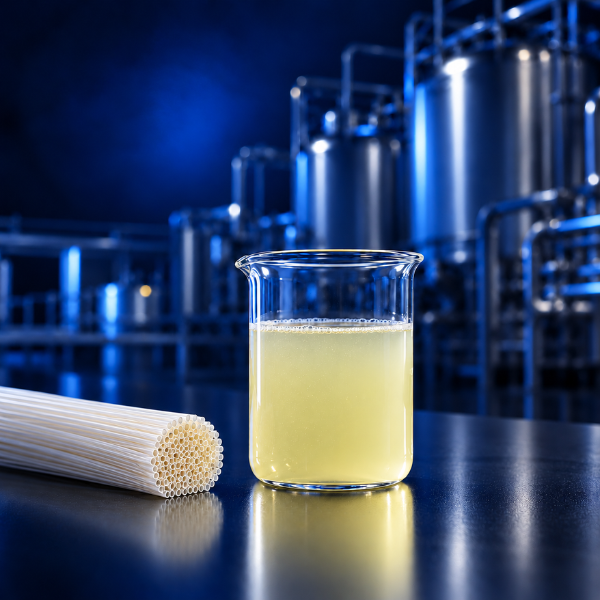
Advanced hollow fiber nanofiltration membranes offer a promising approach to simultaneous lactose concentration and whey demineralization. A 2026 study demonstrated 95% lactose retention in model solutions and 89% in real whey effluent at pH 2.1. A SCHMIDT + HAENSCH refractometer was used to support the characterization of the membrane coatings.
Congratulations to Halil Zengin, Iske Achterhuis, Behnaz Razi Parjikolaei, Niels Ottosen, and Wiebe M. de Vos from the Netherlands and Denmark on their research published in Industrial & Engineering Chemistry Research (2026). Their study, “Whey Demineralization: Selective Lactose Concentration by Using Polyelectrolyte Multilayer Hollow Fiber Nanofiltration Membranes,” investigates a membrane-based approach to improving whey processing and resource recovery.
Why Is Whey Demineralization Challenging?
Whey is a major byproduct of the dairy industry and contains valuable components such as lactose, proteins, and minerals. However, its complex composition makes efficient separation challenging. The separation of lactose from dissolved salts is an important step in recovering valuable components from whey effluent.
How Can Nanofiltration Membranes Improve Lactose Separation?
The research team developed hollow fiber nanofiltration membranes using polyelectrolyte multilayers. These membranes can be carefully tuned to achieve high lactose retention while allowing salts to pass through. The results demonstrated 95% lactose retention in model solutions, while separate single-salt tests showed less than 10% retention of MgCl₂ and CaCl₂. When tested with real whey effluent at pH 2.1, the membranes achieved 89% lactose retention with low salt retention. An important finding of this work is the role of pH in separation performance. The researchers showed that molecular interactions, particularly between calcium and citric acid, influence salt retention and the degree of demineralization. These findings highlight the potential of advanced membrane design to combine lactose concentration and whey demineralization in a single separation step.
How Did SCHMIDT + HAENSCH Refractometry Contribute to the Research?
Refractive index measurements were an important part of the membrane characterization. The researchers used a SCHMIDT + HAENSCH ATR ST automatic critical-angle refractometer to measure refractive index increments of poly(styrene sulfonate) (PSS) solutions at a background salt concentration of 250 mM NaCl. These measurements provided input for the optical model used to quantify polyelectrolyte adsorption during membrane characterization. This research illustrates how refractive index measurements can support the characterization of materials used in advanced membrane development. We thank the research team for using our ATR ST refractometer as part of their scientific work and wish them continued success in their future research!
Original Research Publication: Zengin, H.; Achterhuis, I.; Razi Parjikolaei, B.; Ottosen, N.; de Vos, W. M. (2026). Whey Demineralization: Selective Lactose Concentration by Using Polyelectrolyte Multilayer Hollow Fiber Nanofiltration Membranes. Industrial & Engineering Chemistry Research, 65(16), 8437-8447. Published online: April 16, 2026. DOI: 10.1021/acs.iecr.6c00345
Explore SCHMIDT + HAENSCH Refractometry
SCHMIDT + HAENSCH develops laboratory refractometers for precise refractive index measurements across a wide range of analytical applications. Explore our current ATR V/VT laboratory refractometers or learn more about the measurement principle in our educational article What Is Refractometry?.