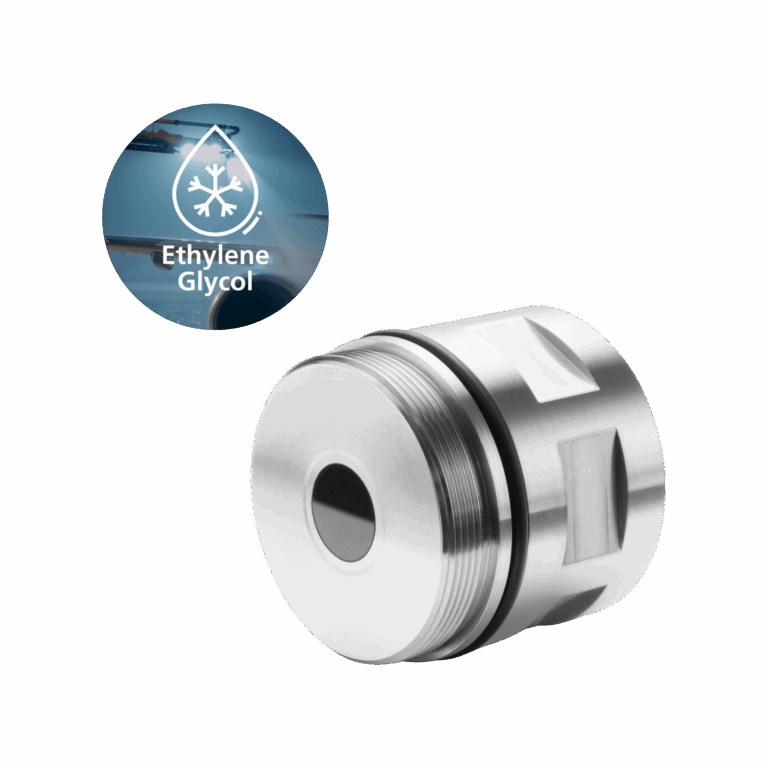
SCHMIDT + HAENSCH provides inline refractometry solutions for continuous propylene glycol concentration monitoring in liquid-cooled data centers. By measuring refractive index and temperature directly in the cooling circuit, the iCS² PG Inline Concentration Sensor determines PG concentration in real time and helps detect dilution, concentration drift, and incorrect coolant make-up. Reliable glycol concentration control supports stable coolant flow, heat transfer, freeze and corrosion protection, microbial control, and the reliable operation of critical CDU and direct-to-chip cooling circuits.
Why Propylene Glycol Concentration Matters in Data Center Cooling
Data centers are fundamental to the uninterrupted operation of today’s digital infrastructure. As artificial intelligence (AI), high-performance computing (HPC), and increasingly dense server configurations drive rack power and heat density to new levels, cooling has become one of the most critical factors for infrastructure reliability, computing performance, and operating efficiency.
Traditional air cooling is increasingly challenged by these high and sustained heat loads. Direct liquid cooling (DLC), particularly direct-to-chip cold-plate cooling, transfers heat directly from processors into a circulating coolant. Such systems can support rack loads of 100 kW and above. However, the coolant must pass through extremely narrow channels close to the heat-generating components, making stable coolant composition and reliable fluid quality essential.
Propylene glycol (PG)/water mixtures are commonly used as heat-transfer fluids in these cooling systems. In addition to providing freeze and corrosion protection, PG contributes to suppressing microbial growth. At a typical concentration of approximately 25% PG, biological growth can be effectively controlled under the intended operating conditions. This is especially important in the sensitive cooling circuits inside the data center, where microbial growth and biofilm formation can restrict or even block the very narrow cooling channels.
Continuous refractive-index measurement with an
inline refractometer provides an effective method for monitoring PG concentration in real time. Because
refractive index (RI) is temperature-dependent, both refractive index and coolant temperature are measured and evaluated together to determine the actual PG concentration.
By continuously monitoring this critical parameter directly within the cooling circuit, an inline refractometer makes an essential contribution to maintaining stable coolant conditions and ensuring reliable, uninterrupted cooling in this highly sensitive and critical data center infrastructure.
Cooling from White Space to Grey Space and the Outdoor Environment
Data-center cooling can be divided into three functional zones: white space, grey space, and black/outdoor space.
The white space contains the computing equipment and CDUs. Heat generated by processors is absorbed by the liquid cooling circuit and transferred through the CDUs to the facility cooling system.
The grey space contains supporting infrastructure such as pumps, chillers, heat exchangers, UPS systems, switchgear, and building-management equipment. The heat received from the white-space cooling circuits is transferred through this infrastructure toward the facility’s heat-rejection system.
Finally, the black or outdoor space includes utility infrastructure and outdoor heat-rejection equipment. The heat originally generated by the processors is ultimately rejected into the external environment.
In simplified form, the thermal path is therefore:
Chip / Server → Cold Plate → CDU → Grey-Space Cooling System → Outdoor Heat Rejection
Each cooling loop has different operating requirements, but wherever a glycol/water mixture is used, concentration control is relevant and the white space in general and the cooling of the CDUs are the most critical cooling areas of the data center.
Why Propylene Glycol Concentration Must Be Controlled
Accurate PG concentration is a critical operating parameter rather than simply a coolant specification. A typical PG-based heat-transfer fluid can contain approximately 25% propylene glycol, with high-purity water performing most of the thermal work. Both over-concentration and under-concentration have important consequences.
Too much PG means unnecessary cost and reduced thermal efficiency. Higher glycol concentrations increase viscosity and pumping requirements while reducing the heat capacity of the coolant. Using more PG than required can therefore waste glycol as well as energy.
Too little PG can be much more critical. PG contributes to biological stability and suppresses microbial growth. If the concentration becomes too low, microorganisms and algae can grow and biofilms may develop. In the narrow cooling channels of cold plates and manifolds, these deposits can restrict coolant flow and eventually obstruct individual passages.
The consequence can be severe. If coolant can no longer flow adequately through a cold plate, heat cannot be removed effectively from the processor. The chip temperature rises, server performance and reliability are compromised, and in extreme cases expensive processors or other components can be damaged. This makes coolant concentration control particularly important because data centers are critical infrastructure operating under highly sensitive thermal conditions. Cooling must remain available continuously, and server temperatures must never be allowed to rise beyond their permitted operating range.
Why Continuous Monitoring Is Essential
Manual sampling can provide information about coolant concentration at a particular point in time, but it cannot continuously detect concentration changes. In critical data-center infrastructure, deviations should ideally be identified before they can affect cooling performance.
An
inline process refractometer measures directly in the circulating coolant. The instrument continuously measures the refractive index of the PG/water mixture and can immediately detect dilution, concentration drift, incorrect top-up, or other deviations from the specified operating range.
Continuous monitoring is particularly valuable for CDU circuits because they supply the narrow cold-plate and manifold passages in high-density server systems.
Ideally, all three relevant cooling levels should be equipped with concentration monitoring wherever glycol/water mixtures are present, with particular emphasis on the white-space circuits. In addition, each individual CDU should be monitored with its own sensor so that concentration deviations can be detected locally rather than only at facility level.
This creates a continuous measurement chain from the highly sensitive server cooling circuits through the facility infrastructure to glycol-containing outdoor or heat-rejection loops.
Determining PG Concentration from Refractive Index and Temperature
The refractive index of a propylene glycol/water mixture changes systematically with its composition. This relationship makes refractometry particularly suitable for continuous concentration measurement.
SCHMIDT + HAENSCH established an application-specific concentration curve. PG concentration is calculated from the combination of measured RI and temperature.
An inline refractometer performs this measurement continuously in the coolant stream and converts the optical signal together with temperature information into a real-time concentration value. This enables automated monitoring without depending solely on manual sampling.
Why Correct PG Concentration Protects Cooling Performance
Maintaining the correct PG concentration provides several operational benefits:
- Suppression of microbial growth and improved biological stability
- Reduced risk of biofilm formation and blocked microchannels
- Stable coolant flow through cold plates and manifolds
- Reliable heat transfer from processors
- Appropriate freeze and corrosion protection
- Reduced unnecessary glycol consumption
- Lower hydraulic resistance compared with excessive PG concentrations
- Improved pumping and overall cooling efficiency
- Immediate detection of dilution or incorrect coolant make-up
- Increased reliability of critical data-center infrastructure
iCS² PG Inline Concentration Sensor for Data Center Cooling
For continuous monitoring of glycol-based cooling fluids, SCHMIDT + HAENSCH offers the iCS² PG Inline Concentration Sensor. Installed directly into the cooling circuit, the compact process refractometer continuously determines propylene glycol concentration and provides real-time information to operators and control systems without requiring continuous manual sampling.
In the white space, the sensor can monitor individual CDU circuits supplying high-density racks and direct-to-chip cold plates. This represents a particularly critical measurement point because incorrect coolant composition can directly affect the ability to remove heat from expensive computing hardware.
In grey-space facility loops, concentration monitoring can verify that glycol remains within the specified operating range required for reliable freeze, corrosion, and biological protection. Outdoor and heat-rejection circuits can likewise be monitored wherever glycol is required for low-temperature protection.
Via its
Modbus RTU interface, the sensor can be integrated into existing process and data-center control systems, allowing deviations from the specified concentration to be detected immediately and corrective action to be initiated.
Benefits of Continuous Propylene Glycol Concentration Monitoring
Continuous refractometric monitoring provides important advantages for modern liquid-cooled data centers:
- Continuous, real-time PG concentration monitoring
- Temperature-compensated refractive-index measurement
- Concentration calculation based on RI and temperature
- Fast detection of dilution and concentration drift
- Individual monitoring of critical CDU circuits
- Reduced manual sampling and laboratory analysis
- Protection against excessive or insufficient glycol concentration
- Support for optimized pumping and heat-transfer efficiency
- Support for freeze, corrosion, and biological protection strategies
- Direct integration into data-center control systems
- No moving measuring components
- Robust optical measurement principle
- Improved coolant consistency and system reliability