Sugar leakage detection in boiler feedwater can be achieved through continuous inline refractometry, helping sugar producers identify contamination in condensate at an early stage. By monitoring changes in process water quality in real time, operators can take corrective action before contaminated condensate reaches critical boiler equipment.
Real-Time Monitoring of Sugar Contamination in Boiler Feedwater
Sugar leakage detection in boiler feedwater can be performed continuously by monitoring changes in
refractive index in the condensate with a high-resolution inline refractometer. In sugar production plants, the generated steam plays a central role in transferring thermal energy during processes such as evaporation and crystallization. During sugar juice concentration, generated steam is reused across multiple process stages to improve energy efficiency. Once condensed, it forms high-purity water that is commonly recycled as boiler feedwater.
However, process leakages can introduce sugar into the condensate. Even relatively small concentrations of sugar can negatively affect boiler performance and may eventually lead to operational instability, equipment damage, or plant shutdowns. Continuous monitoring of condensate and boiler feedwater quality is therefore essential for maintaining reliable and safe plant operation.
A high-resolution inline refractometer provides an effective solution for detecting very low concentration changes directly within the process line. By continuously monitoring changes in total dissolved substances, sugar contamination can be detected at an early stage, allowing operators to initiate corrective actions before contaminated condensate reaches the boiler. Changes in refractive index can indicate sugar contamination in the condensate.
Why Is Sugar Contamination Critical in Boiler Feedwater?
In a typical sugar mill, juice is concentrated in evaporators while steam is reused across multiple effects. The resulting condensate is collected and returned to the boiler. Under normal operating conditions, this condensate is clean and suitable for reuse. Leaks from heat exchangers, evaporators, or crystallizers can, however, introduce sugar into the condensate system. If this contamination remains undetected, the condensate may become unsuitable for reuse and can create significant operational risks.
Sugar contamination in boiler feedwater can result in:
- Foaming and carryover in boilers
- Corrosion and fouling of boiler components
- Reduced heat transfer efficiency
- Unplanned shutdowns and maintenance
Even relatively small sugar concentrations can cause significant damage. In extreme cases, excessive sugar levels may lead to severe operational problems and force plant shutdowns. Early and reliable detection is therefore essential for protecting critical equipment and maintaining stable plant operation.
Why Early Detection of Sugar Leakage Matters
Early sugar leakage detection in boiler feedwater allows plant operators to respond before contaminated condensate reaches sensitive boiler equipment. This makes continuous water-quality monitoring an important element of process safety and preventive maintenance.
Reliable monitoring helps operators to:
- Support prevention of contaminated condensate entering the boiler
- Detect sugar leakage at an early stage
- Minimize downtime and maintenance costs
- Maintain stable and safe plant operation
- Quickly initiate corrective actions
- Protect critical process equipment
By detecting contamination directly in the condensate and boiler feedwater system, the source of the problem can be addressed before sugar accumulation results in more serious process disturbances.
How Is Sugar Leakage Detected in Boiler Feedwater?
A common approach to identifying sugar ingress is the continuous monitoring of total dissolved substances (TDS) in the condensate. When sugar enters the condensate, the concentration of dissolved solids increases. Changes in refractive index can indicate sugar contamination in the condensate. Continuous measurement makes it possible to identify very low concentration changes in boiler feedwater without relying on periodic sampling alone.
The basic detection principle is therefore straightforward:
- Sugar enters the condensate due to process leakage
- Sugar ingress changes the dissolved-solids content
- The change affects the refractive index / TDS signal
- The change is detected directly by an inline measurement system
- Operators receive immediate information about water quality
- Corrective action can be initiated before contamination reaches the boiler
This approach provides continuous information about the process and enables significantly faster reaction to contamination events.
Inline Refractometry for Continuous Condensate Monitoring
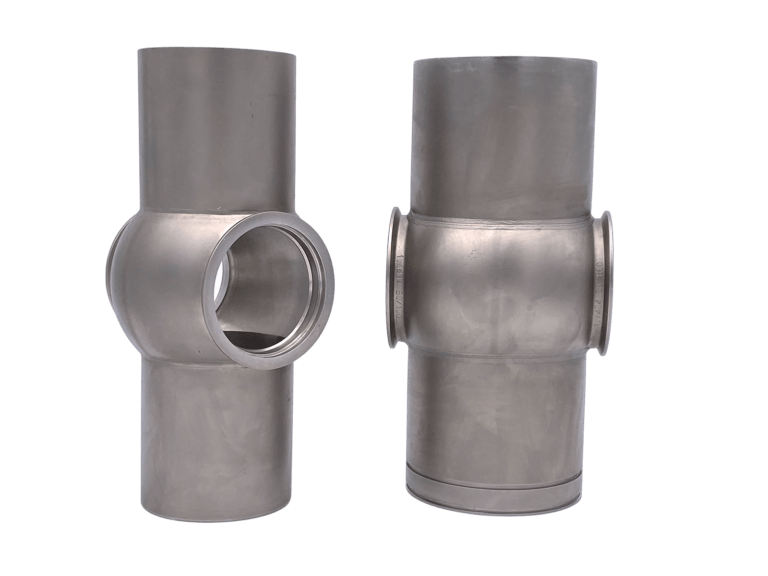
A high-resolution inline refractometer provides a practical method for monitoring very low concentration changes directly within the process line. Unlike laboratory-based measurements that require samples to be collected and analyzed separately, an inline refractometer continuously monitors the process medium. This enables real-time detection of changes in condensate composition and provides immediate information about potential sugar carryover. For sugar mill applications, the refractometer can be integrated at critical points in the condensate and boiler feedwater system. If contamination occurs, alarms can be triggered and corrective actions initiated before sugar reaches the boiler. Monitoring is therefore particularly valuable at critical points within the condensate and boiler feedwater system.
Important monitoring points include:
- Condensate systems
- Condensate tanks
- Boiler feedwater systems
- Critical process points where sugar carryover may occur
By integrating
inline measurement technology at these locations, operators gain immediate insight into water quality and can respond rapidly when contamination is detected. Continuous inline measurement therefore supports both process control and preventive protection of boiler equipment.
Benefits of Inline Sugar Leakage Detection
Continuous inline monitoring offers several advantages for sugar production and boiler feedwater quality control:
- Detection of very low concentration changes
- Real-time monitoring
- Robust and low-maintenance design
- Reduced need for manual sampling
- Flexible integration with common process control systems
- Improved process safety
- Supports prevention of contaminated condensate entering the boiler
- Reduced downtime and maintenance requirements
- Reduced laboratory workload
- Potential cost savings
Because measurements are performed continuously in the process line, operators can identify contamination immediately rather than waiting for results from manually collected samples.
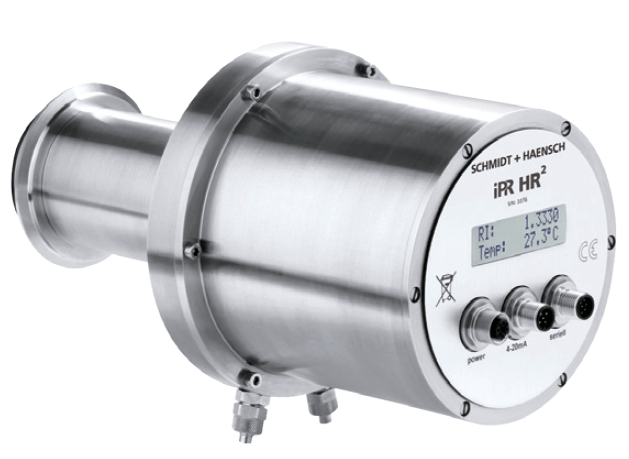
iPR HR² High-Resolution Inline Process Refractometer for Sugar Leakage Detection
The
SCHMIDT + HAENSCH iPR HR² High-Resolution Inline Process Refractometer provides a precise solution for applications requiring high measurement accuracy directly in the process line. This device is designed to provide inline measurements with precision comparable to laboratory analysis and is particularly suitable for monitoring very low concentration changes.
This makes the
iPR HR² well suited for detecting potential sucrose carryover in condensate tanks. By integrating the refractometer into critical points of the condensate and boiler feedwater system, plant operators gain immediate information about changes in water quality. In the event of contamination, alarms can be triggered and corrective actions initiated before sugar reaches the boiler. This helps prevent operational problems such as fouling, corrosion, and costly downtime.
Process Integration and Real-Time Monitoring
Such
real-time monitoring supports a proactive approach to process safety. Instead of identifying contamination only after operational problems occur, plant operators can respond to changes as they develop. Reliable control of condensate quality is essential for safe and efficient operation in sugar production plants. Even small amounts of sugar entering the condensate can cause serious problems when contaminated water is returned to the boiler. Continuous inline measurement enables contamination to be identified at an early stage and allows corrective actions to be initiated before critical equipment is affected.
The
SCHMIDT + HAENSCH iPR HR² High-Resolution Inline Process Refractometer provides laboratory-level measurement accuracy directly in the process and is designed for detecting very low concentration changes. With real-time monitoring, flexible process integration, and reduced need for manual sampling, the system provides an effective solution for detecting sugar leakage, protecting boiler systems, reducing downtime, and improving process safety in the sugar and food & beverage industries.