

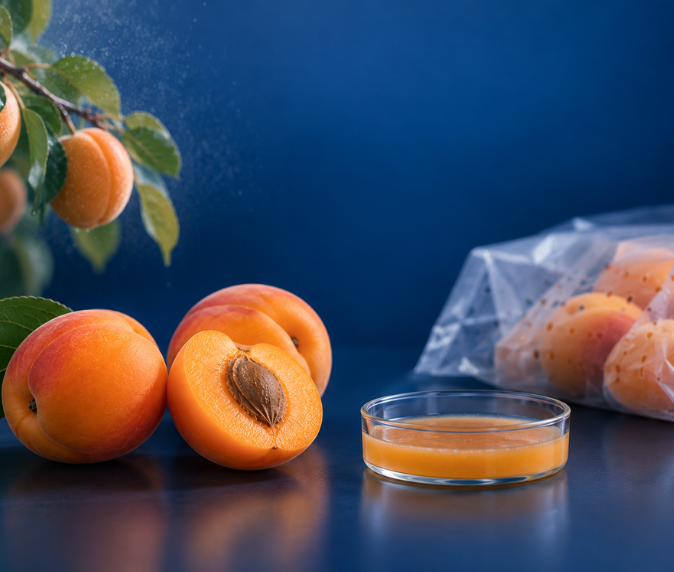
How strongly do growing conditions influence apricot quality and the effectiveness of treatments used to preserve it?
A recent study from Serbia investigated how preharvest calcium (Ca) application and postharvest treatments, including modified-atmosphere packaging (MAP) and 1-methylcyclopropene (1-MCP), influence apricot quality during storage and shelf life over two contrasting growing seasons.
For the fruit quality control analysis, the researchers examined parameters including color, acidity, total soluble solids (TSS), carotenoids, phenols and sensory attributes after 15 days of cold storage followed by 3 days of shelf life.
Growing conditions influenced treatment effectiveness
The results showed that climatic conditions were the main factor shaping apricot quality and the success of the individual treatments.
Preharvest calcium reduced firmness loss by up to 30%, particularly under wetter conditions.
Modified-atmosphere packaging delayed ripening and maintained acidity, while 1-MCP preserved texture but reduced sweetness and aroma, particularly in the drier year.
Overall, calcium showed the strongest effects under wetter conditions, while MAP provided more consistent quality across different growing conditions.
These findings demonstrate that the effectiveness of treatments used to maintain apricot quality can vary depending on the conditions under which the fruit is grown.
Refractometry and TSS measurement in apricot quality control
Refractometry plays an important role in fruit quality control by enabling the measurement of soluble solids, an important parameter when assessing fruit quality and ripening.
In this study, total soluble solids were one of the physicochemical parameters used to evaluate apricot quality. TSS refers to the concentration of dissolved substances in the fruit juice, primarily sugars along with other soluble components.
For the TSS measurements, the researchers used a SCHMIDT + HAENSCH ATR ST Refractometer. The resulting TSS data were evaluated alongside other quality parameters to assess differences between treatments, storage periods and growing conditions.
TSS was also considered in relation to acidity as part of the evaluation of fruit ripening and quality. This allowed the refractometric results to contribute to the broader physicochemical and sensory assessment of the apricots.
For more than 160 years, SCHMIDT + HAENSCH has been developing precision measurement solutions for demanding analytical applications. As a global leader in refractometry, we provide high-precision measurement technology for laboratory, research and industrial process applications across a wide range of industries.
Congratulations to the authors of “Interannual Variability in Apricot Quality: Role of Calcium and Postharvest Treatments During Cold Storage and Shelf Life” for their important contribution to fruit quality research and sustainable horticultural practices.
Read the scientific paper: https://www.mdpi.com/2311-7524/11/9/1140
Discover our Refractometer Portfolio
Laboratory refractometers: https://schmidt-haensch.com/product-category/laboratory-instruments/laboratory-refractometer/
Benchtop Laboratory Refractometers ATR V/VT: https://schmidt-haensch.com/product/atr-v/
Inline process refractometers: https://schmidt-haensch.com/product-category/inline-process-analysis/
