
What Is Camphor and How Is It Used in Pharmaceutical Products?
Camphor is an organic compound obtained from natural sources such as the camphor tree, Cinnamomum camphora, or produced synthetically from compounds including α-pinene. It is a white, crystalline or wax-like solid with a characteristic aromatic odor. Camphor is used in pharmaceutical and related products such as:- Topical ointments and creams
- Cooling gels and anti-itch preparations
- Inhalation and vapor products
- External analgesic formulations
- Selected cosmetic and dental products
Why Is Camphor Optically Active?
Camphor (C₁₀H₁₆O) is a bicyclic monoterpene ketone with a rigid three-dimensional structure. Its molecular asymmetry makes camphor chiral and enables its enantiomers to rotate plane-polarized light in opposite directions. Camphor occurs in two mirror-image forms known as enantiomers:- (+)-camphor, which is dextrorotatory
- (−)-camphor, which is levorotatory
Why Is Quality Control of Camphor-Containing Products Important?
Pharmaceutical manufacturers must ensure that camphor raw materials and camphor-containing products meet defined requirements for identity, content, purity, and batch consistency. An incorrect camphor content may affect product performance and lead to non-compliance with the approved formulation or internal product specification. Variations in raw-material quality, sample preparation, or product composition may also result in:- Inconsistent product performance
- Batch-to-batch variation
- Deviations from established specifications
- Additional laboratory investigations
- Rejected raw materials or finished batches
- Regulatory and documentation challenges
How Does Camphor Determination by Polarimetry Work?
Polarimetry measures the angle through which an optically active sample rotates plane-polarized light. A prepared solution containing an excess of one camphor enantiomer produces a measurable net optical rotation. The observed optical rotation depends on:- Camphor concentration
- The relative proportions of the camphor enantiomers
- Optical path length
- Measurement temperature
- Measurement wavelength
- Solvent and sample preparation
- Other optically active substances in the sample
- Support camphor identification
- Compare a sample with a defined optical-rotation range
- Perform camphor content determination
- Support a camphor assay in pharmaceutical products
- Assess batch-to-batch consistency
- Distinguish strongly dextrorotatory material from approximately racemic material
- Identify deviations requiring further investigation
Which Factors Affect the Optical Rotation of Camphor?
Polarimetry measures the combined optical activity of all optically active substances present in the prepared sample. A deviation from the expected result may be caused by:- An incorrect camphor concentration
- A change in the relative proportions of the enantiomers
- Interference from another optically active substance
- Incomplete extraction
- Incorrect dilution or sample preparation
- Deviations in solvent composition
- Incorrect measurement temperature
- A different measurement wavelength
- An incorrect optical path length
Which Official Method Applies to Camphor Determination by Polarimetry?
AOAC Official Method 926.18
AOAC Official Method 926.18 is titled Camphor in Drugs: Polarimetric Determination. It documents an established polarimetric method for camphor analysis. The official method defines the analytical scope, sample preparation, measurement conditions, potential corrections, and calculation procedure that must be followed during implementation. For pharmaceutical laboratories, the applicable AOAC method, pharmacopoeial monograph, validated internal procedure, and product specification determine the exact analytical requirements for the sample.Why Is the VariPol Polarimeter the Ideal Solution for Camphor Determination?
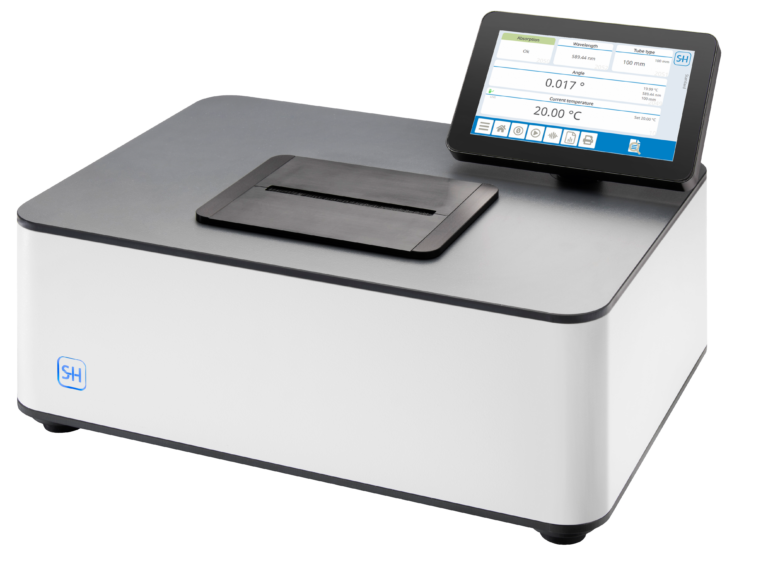
Camphor determination by polarimetry requires precise control of wavelength, temperature, optical path length, and measurement conditions. The SCHMIDT + HAENSCH VariPol combines these capabilities in a modular polarimeter developed for accurate and reproducible optical-rotation measurements in pharmaceutical quality control. With wavelength configurations including 589 nm, integrated Peltier temperature control, configurable analytical methods, and pharmaceutical data-management options in accordance with the requirements of 21 CFR Part 11, VariPol provides a complete solution for camphor identification, content determination, and routine batch testing.Measurement at the Required Wavelength
Many established optical-rotation procedures use the sodium D-line at approximately 589 nm. VariPol is available with wavelength configurations that include 589 nm, enabling laboratories to perform camphor analysis under the wavelength conditions defined by commonly used polarimetric methods.Precise Integrated Temperature Control
The optical rotation of camphor is temperature-dependent. VariPol’s integrated Peltier temperature-control system maintains stable sample conditions directly within the instrument. This supports reproducible measurements, improves result comparability, and reduces deviations caused by temperature fluctuations.Measurement of Optical and Specific Rotation
VariPol measures observed optical rotation and supports the determination of specific rotation based on the defined sample concentration and optical path length. This enables laboratories to compare camphor samples with established optical-rotation specifications and perform camphor content determination according to a validated analytical method.High Precision and Repeatability
Camphor identification, content determination, and batch comparison require stable and reproducible results. VariPol provides the measurement precision and repeatability needed for reliable quality-control decisions across samples, analysts, and production batches.Standardized Routine Methods
Measurement procedures can be configured and stored for routine laboratory use. Defined methods ensure that analysts consistently apply the correct wavelength, temperature, measurement mode, and evaluation parameters. This reduces operator influence and supports standardized testing during incoming inspection, production control, and final product testing.Support for Regulated Pharmaceutical Workflows
When combined with Aquisys3 Premium Pharma, VariPol supports controlled, secure, and traceable laboratory workflows. Depending on the selected system configuration, available functions include:- Controlled user access
- Password-protected user administration
- Standardized measurement methods
- Audit-trail functionality
- Traceable data handling
- Encrypted storage of measurement results
- Integration into pharmaceutical laboratory workflows
- Compliance-oriented documentation
Modular Configuration for Pharmaceutical Laboratories
VariPol can be configured according to the requirements of the analytical method and laboratory workflow, including:- Measurement wavelength
- Temperature-control range
- Software configuration
- Data-management requirements
How Does VariPol Support Camphor Quality Control?
VariPol provides a complete measurement solution for:- Incoming inspection of camphor raw materials
- Camphor identification
- Optical-rotation testing of prepared camphor samples
- Camphor content determination
- Camphor assay in pharmaceutical products
- Batch-to-batch comparison
- Pharmacopoeial optical-rotation testing
- Assessment of stereochemical consistency
- Research and analytical-method development
By combining precise optical measurement, controlled sample
temperature, standardized methods, and pharmaceutical data-management capabilities according to 21 CFR Part 11, VariPol enables efficient, reproducible, and reliable camphor quality control.