
How does refractive index measurement support contact lens material testing?
Contact lenses are precision medical devices used to correct vision directly on the eye. Their optical performance depends on both the lens geometry and the refractive index of the material. Therefore, contact lens refractive index measurement is essential for reliable contact lens quality control and accurate contact lens material testing. Modern lenses are typically made from polymer materials and can be classified into:- Hydrophilic, or soft, lenses, which absorb water and change their refractive index depending on hydration
- Hydrophobic, or rigid, lenses, which are more dimensionally stable but require precise surface handling during measurement
Why is the refractive index important for contact lenses and intraocular lenses?
Contact lenses and intraocular lenses, or IOLs, are highly sophisticated optical components used to correct vision. Their performance is directly determined by the refractive index of the lens material, which defines the optical power, or dioptre, and overall visual quality. Precise control of refractive index during material development, production, and quality control is therefore essential to ensure consistent lens performance and patient safety. Modern ophthalmic production requires high-precision refractive index measurement across different wavelengths and temperatures to fully characterize optical materials, ophthalmic lens materials, and polymer lens materials. For intraocular lens refractive index measurement, IOL quality control, and IOL material characterization, reliable optical material testing supports consistent product performance and medical device quality control.Why is monitoring refractive index essential for ophthalmic lens quality control?
Without precise measurement, manufacturers risk:- Incorrect optical power, including dioptre deviations
- Inconsistent product quality
- Increased batch rejection rates
- Determination of refractive index
- Characterization of polymer materials used for lenses
- Quality control of incoming raw materials and finished products
Why is dispersion measurement important for contact lens materials?
In addition to the refractive index at a single wavelength, the dispersion behavior of contact lens materials is highly important. The refractive index varies with wavelength, influencing how light is transmitted and focused by the lens. Multiwavelength refractometry enables the determination of the dispersion curve over a broad spectral range, such as 360–960 nm, closely representing the visible and near-visible region relevant for human vision. Dispersion measurement of contact lenses allows a detailed understanding of the optical properties of contact lenses and ophthalmic materials. This allows:- Accurate simulation of real optical behavior in the eye
- Detailed characterization of polymer materials
- Optimization of lens design and performance
Which refractometer is suitable for multiwavelength contact lens measurement?
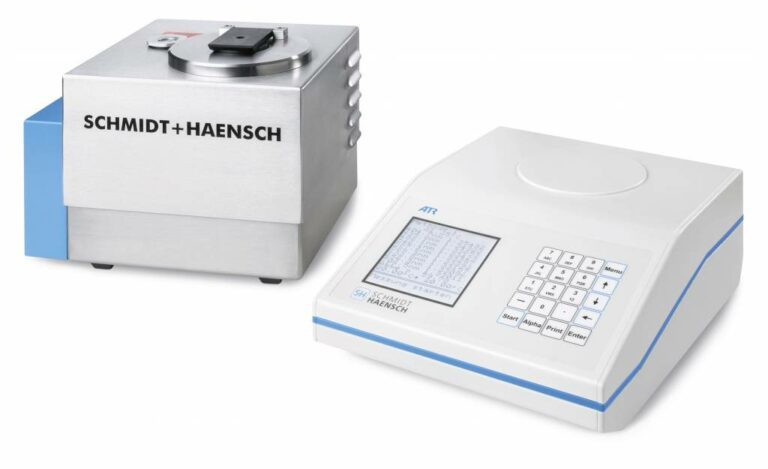
Using the SCHMIDT + HAENSCH Multi-Wavelength Refractometer ATR L provides a precise method for determining the refractive index and dispersion curve of contact lens materials. The SCHMIDT + HAENSCH ATR L is a laboratory refractometer for contact lenses, ophthalmic materials, and polymer materials. The instrument enables measurements across multiple wavelengths, allowing comprehensive characterization of optical properties relevant to lens performance. Integrated temperature control ensures accurate temperature-controlled refractive index measurement under defined conditions. The ATR L Multi-Wavelength Refractometer is ideally suited for laboratory use, supporting both material development and routine quality control of contact lenses and their polymer raw materials. As a multiwavelength refractometer for contact lenses, it supports refractive index and dispersion curve measurement for optical material characterization.How are solid contact lens samples measured accurately?
For solid samples such as contact lenses, it is generally recommended to use a solid sample clamp. This supports reliable measurement of solid contact lens samples and improves handling during contact lens material testing. Additionally, the use of a suitable contact liquid, such as diiodomethane, is advised to improve optical coupling and measurement accuracy. A contact liquid for refractive index measurement, such as diiodomethane contact liquid, supports accurate optical coupling between the sample and the measuring surface.What are the benefits of refractive index measurement in contact lens quality control?
The main advantages include:- High-precision refractive index measurement
- Measurement across 7 wavelengths for dispersion analysis
- Temperature-controlled measurements under application conditions
- Fast and reproducible results
- Reduced batch rejection and improved yield
- Reliable contact lens quality control
- Consistent optical power
- Dioptre deviation control
- Better control of polymer raw materials
- Support for material development and routine quality control
- Improved ophthalmic product performance
Where is refractive index measurement used in ophthalmic, polymer, and optical material development?
Reliable quality control of optical materials is used in:- Contact lens manufacturing
- Intraocular lens, or IOL, production
- Ophthalmic materials research
- Polymer and optical material development
- The medical device industry