Jam, marmalade, and similar fruit preserves are produced by concentrating fruit mixtures with sugar to achieve a stable gel-like consistency and long shelf life. The final product quality strongly depends on the Brix value, which defines the concentration of dissolved solids, mainly sugar.
Typical Brix ranges are:
- Jam: 10–70 °Brix
- Marmalade: 50–85 °Brix
In standard jam formulations, products often consist of approximately 50% fruit and 50% sugar, resulting in final concentrations of around 60–70 °Brix. Maintaining this concentration is essential for taste, texture, preservation, and product stability.
Depending on the product category and regional regulations, fruit preserves are often required to meet defined fruit content and soluble solids specifications. For example, the German Konfitürenverordnung (KonfV) specifies minimum fruit contents for different jam and marmalade products and requires more than 55% soluble dry matter for most preserves. These requirements make reliable Brix monitoring an important tool for both quality assurance and regulatory compliance.
Modern food production increasingly requires continuous in-line Brix concentration measurement to ensure consistent quality and efficient process control.
Why Is Brix Control Important in Jam Production?
Jam production is typically carried out in batch processes of 500 to 3,000 kg, lasting 1–3 hours, and involves several key phases:
- Ingredient addition: Fruits, sugar, pectin, and water are mixed
- Sweetening and cooking: Sugar is absorbed by the fruit until equilibrium is reached below 90 °C
- Pasteurization: Temperature increases to 100–150 °C for microbial stabilization
- Cooling: Product is cooled to 20–40 °C
Throughout these phases, sugar concentration, temperature, and viscosity continuously change, directly influencing the final product quality. This makes Brix control in jam production essential.
Continuous in-line Brix concentration measurement in jam production enables manufacturers to monitor the concentration process in real time and accurately determine the endpoint of cooking. Once the target Brix value is reached, the cooking process can be stopped immediately, preventing overcooking, reducing energy consumption, and ensuring batch-to-batch consistency.
Without real-time monitoring, this can lead to:
- Inconsistent product quality
- Excessive sugar usage
- Increased production time
- Higher risk of batch rejection
How Is Brix Measured in Marmalade and Fruit Preserves?
The refractive index (RI) is ideal for monitoring sugar concentration in jam and marmalade production. Refractive index Brix measurement is therefore a suitable method for continuous process control.
Inline refractometers measure the refractive index continuously and convert it into a Brix scale, enabling precise real-time control of the cooking process.
Inline refractometers measure continuously and provide:
- Measurement ranges typically from 0 to 100 °Brix
- Real-time output signals, such as 4–20 mA or digital signals, for process control
- Immediate detection of deviations
These output signals can be integrated directly into PLC, DCS, or SCADA systems, allowing automatic process adjustments based on the measured Brix value. Depending on the production setup, the refractometer signal can be used to optimize feed rates, cooking duration, or batch endpoint control without operator intervention.
This approach allows:
- Continuous tracking of concentration changes
- Optimization of cooking time
- Reduction of raw material consumption
- Stable and reproducible product quality
Which SCHMIDT + HAENSCH Inline Process Refractometer Is Optimal for the Food Industry?
In-line Brix concentration measurement in the food industry provides a reliable method for monitoring Brix values during jam and marmalade production.
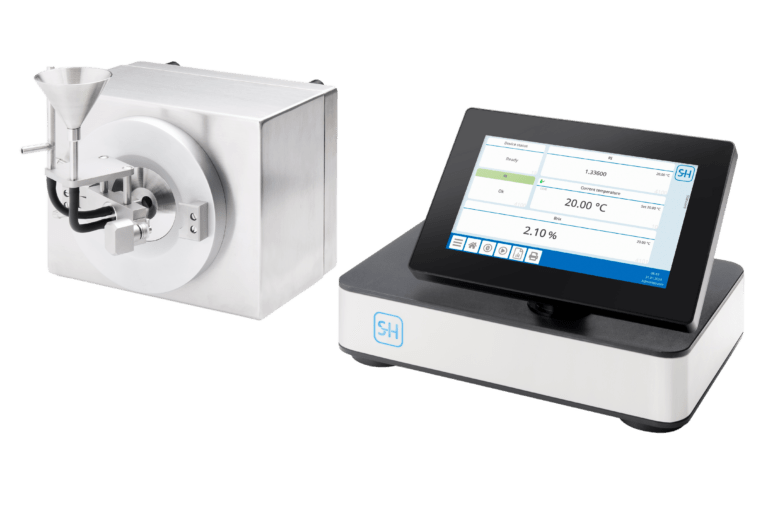
The SCHMIDT + HAENSCH iPR FR2 full-range inline process refractometer provides a reliable method for monitoring Brix values during jam and marmalade production. It can be mounted directly in the cooking pan, providing real-time measurement during the entire cooking process.
The continuous measurement enables operators to follow concentration changes throughout cooking and identify the exact process endpoint when the desired final Brix value is reached. This allows the batch to be stopped at the optimal moment, ensuring consistent product quality while reducing energy consumption and unnecessary processing time. This enables immediate control of concentration and ensures the desired final product quality. Alternatively, the iPR FR2 system can be installed in a bypass line.
The iPR FR2 is SCHMIDT + HAENSCH’s flagship process refractometer and a true all-rounder. It is designed to provide high resolution in two distinct measuring ranges. The integrated water-cooling circuit allows for very high process temperatures. It is ideal for measuring the dry substance content of viscous jams, marmalades, and other concentrated food products.
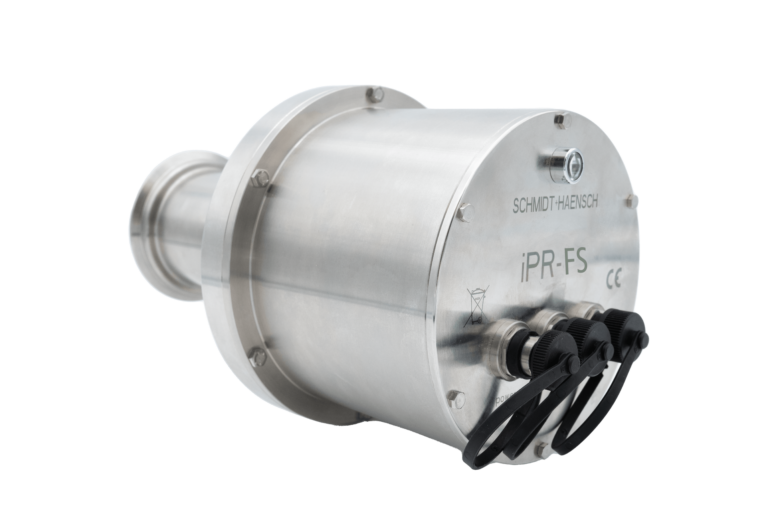
As an alternative,
the SCHMIDT + HAENSCH iPR FS inline process refractometer is specifically designed for hygienic food and beverage applications. The iPR FS is EHEDG-certified and features a hygienic design with rounded surfaces and specially adapted screws that minimize residue build-up and facilitate efficient cleaning. Its sanitary construction makes the iPR FS particularly suitable for marmalade production environments with stringent hygiene requirements, while still providing reliable and accurate inline Brix measurements for continuous process control and quality assurance.
Both SCHMIDT + HAENSCH inline refractometers support CIP processes and help reduce the risk of product residues.
What Are the Benefits of Continuous Brix Measurement in Jam and Marmalade Production?
- Accurate, reliable, and fast measurement
- Continuous inline monitoring
- Reduced production time and costs
- Reduced risk of downtime
- Consistent high product quality
- Automatic batch endpoint detection
- Reduced sampling and laboratory workload
- Integration into PLC and process automation systems
- Reduced risk of operator-dependent process variations
- Improved process reproducibility and traceability
How Do Inline Refractometers Complement Laboratory Refractometers in Jam Quality Control?
Traditionally, measurements were carried out offline using
laboratory refractometers. However, modern production processes require continuous inline monitoring to improve efficiency and automation.
In addition to inline process control solutions, SCHMIDT + HAENSCH offers a range of laboratory and at-line refractometers for quality assurance, product release, and process validation. For laboratory Brix analysis,
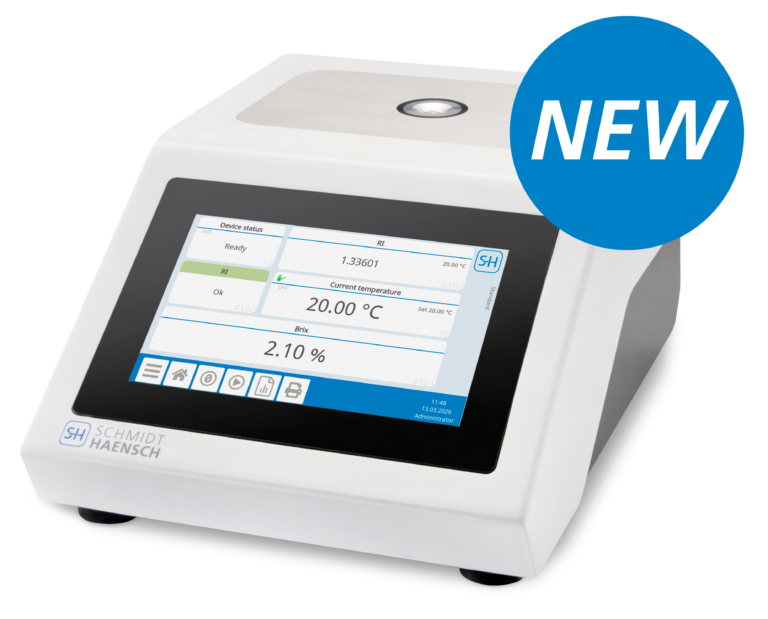
the SCHMIDT + HAENSCH ATR V/VT and
SCHMIDT + HAENSCH ATR P are particularly well suited.
The SCHMIDT + HAENSCH ATR V/VT is a versatile all-round laboratory refractometer available with automatic temperature compensation or precise Peltier temperature control, ensuring reliable and highly accurate measurements across a wide range of applications.
The SCHMIDT + HAENSCH ATR P is a particularly robust laboratory refractometer designed for both horizontal and vertical operation, making it ideal for demanding environments and high sample throughput.
Both SCHMIDT + HAENSCH instruments provide highly precise Brix measurements and support quality control of raw materials and finished jam or marmalade batches, helping manufacturers ensure consistent product quality and compliance with production specifications.
Which Industries Typically Use These Applications?
- Food production
- Jam and marmalade manufacturing
- Fruit processing industry